Tree trimming and pruning in Cary, NC
Good pruning makes a tree safer and healthier without making it look butchered. Dead and weak wood comes out, the crown is opened and clearance is created, using cuts the tree can seal over.
- Dead, broken and hanging limbs removed
- Crown thinning to let wind and light through
- Clearance over roofs, driveways and walks
- Structural pruning for young trees
- Proper cuts outside the branch collar, no topping
Covering Cary · Apex · Holly Springs · Morrisville · Raleigh
Get an estimate for tree trimming and pruning
Pruned to standard
Cuts made outside the branch collar, no topping and no more removed than the tree can spare, following ANSI A300 pruning standards.
Insured crews, safe rigging
Liability and workers compensation coverage, and limbs lowered on ropes rather than dropped when a roof, fence or garden is below.
A written, itemized price
Removal, stump grinding and cleanup priced separately in writing, so you know exactly what is included before work starts.
Why choose us
Trees handled safely, yards left clean
Most tree jobs here happen over a roof, a fence or a neighbor's yard. Careful rigging, proper pruning cuts and a thorough cleanup are what separate good tree work from a costly mess.
- Insured for tree work
- Limbs lowered, not dropped
- Pruning to ANSI A300
- Stump grinding available
- Written, itemized estimates
- Local to Cary
Why trees are pruned
Pruning has a handful of legitimate goals, and a good quote names which ones apply:
- Safety: removing dead, broken, cracked and hanging limbs that could fall.
- Clearance: lifting limbs over roofs, driveways, walks and streets, and away from the house.
- Structure: shaping young trees so they develop one strong trunk and well-spaced limbs.
- Health: taking out diseased or rubbing branches and letting air move through the crown.
- Wind resistance: thinning dense crowns so wind passes through instead of pushing the whole tree.
- Views and light: opening the crown for a view or for lawn and gardens underneath.
How pruning is done right
The industry standard for pruning in the United States is ANSI A300, and the companion safety standard is ANSI Z133. Done to those standards, pruning follows a few rules:
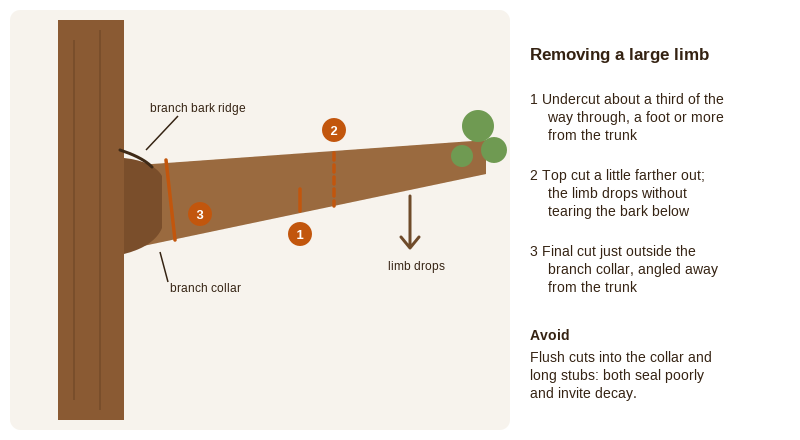
- Cuts are made just outside the branch collar, the swollen ring where a branch joins the trunk. That collar is what grows over the wound. Flush cuts into it and long stubs both lead to decay.
- Large limbs are removed with three cuts, so the weight comes off before the final cut and the bark does not tear down the trunk.
- No more is removed than the tree can spare, generally not more than about a quarter of the living crown in a year, and less from older trees.
- Climbing spikes stay off trees that are being kept, because every spike wound is an injury. Pruning climbers use ropes and saddles.
- No topping, and no lion-tailing, which strips the inner branches and leaves foliage only at the tips.
Types of pruning
- Cleaning removes dead, dying, diseased and broken branches. On most mature trees this is the bulk of the work.
- Thinning removes selected live branches to reduce density and weight, without changing the tree’s overall shape.
- Raising removes lower limbs to clear structures, vehicles and people, ideally keeping at least half of the tree’s height in live crown.
- Reduction shortens the length of limbs or the height of a tree by cutting back to a lateral branch large enough to take over, not to a stub.
- Structural pruning on young trees picks one leader and removes competing stems while they are small, preventing weak forks later.
When to prune
Late winter, while trees are dormant, is the best time for most shade trees in North Carolina: the structure is easy to see without leaves, and wounds start closing as growth begins in spring. Spring-flowering trees, such as dogwoods, redbuds and cherries, are pruned right after they bloom. Dead, broken and hazardous limbs can come off at any time. The guide to when to prune trees in North Carolina goes species by species.
Pruning near roofs and wires
Limbs over roofs are lowered on ropes rather than dropped, and clearance is created by removing whole branches back to a junction instead of shearing the edge of the crown. Tree limb removal covers roof and chimney clearance in detail. For branches near power lines, only line-clearance qualified crews should work within about ten feet of energized lines; for the service line to your house, Duke Energy will disconnect it free of charge so the work can be done safely.
What a pruning quote should say
“Trim the tree” can mean anything. A good quote names the trees, the type of pruning, roughly how much will be removed, the clearance being created and how debris will be handled, and confirms the work follows ANSI A300. Crape myrtles are their own subject; see crape myrtle pruning.
Tree trimming and pruning — common questions
How often should trees be trimmed?
Mature shade trees typically need pruning every three to five years, mostly to remove dead wood and keep clearance. Young trees benefit from lighter structural pruning every year or two while their framework forms.
What is wrong with topping a tree?
Topping cuts large branches back to stubs. The tree responds with a mass of weakly attached sprouts, the stubs decay, and the tree becomes more dangerous and needs cutting again within a few years. Arborist standards reject it.
How much of a tree can be pruned at once?
A common guideline is to remove no more than about a quarter of the living crown in a year, and much less from a mature or stressed tree. Removing too much starves the tree and triggers weak regrowth.
Should pruning cuts be painted or sealed?
No. Research has shown wound dressings do not prevent decay and can trap moisture. A proper cut just outside the branch collar is what lets the tree seal the wound itself.
Problems this fixes
Often booked with this