Cracked or hollow tree trunk: is the tree still safe?
Plenty of hollow trees stand for decades. What matters is how thick the wall of sound wood is, where the crack or cavity sits, and whether it is getting worse.
What you may notice
- A crack running up or down the trunk, or through a fork
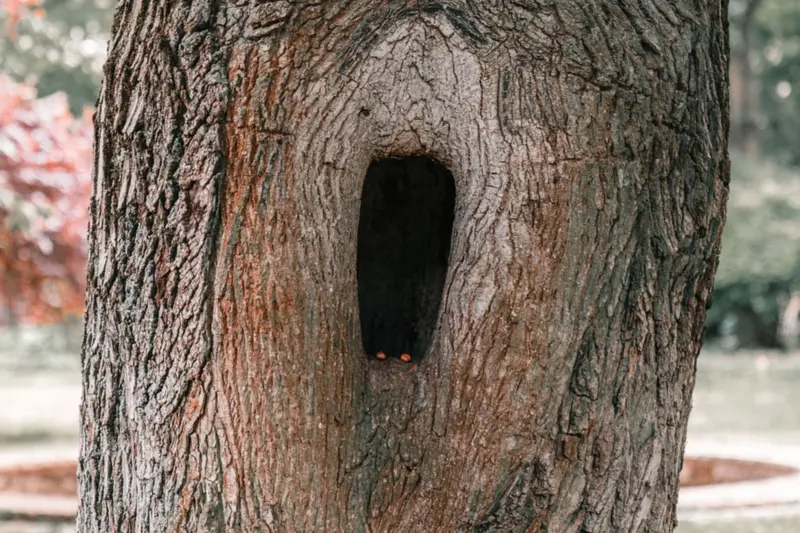
- An opening into a hollow center, or a cavity at the base
- Bark split open, with a ridge of new wood along the edges
- Soft, punky or crumbling wood inside an opening
- Woodpeckers, carpenter ants or bees working the trunk
Tell us about the tree
Pruned to standard
Cuts made outside the branch collar, no topping and no more removed than the tree can spare, following ANSI A300 pruning standards.
Insured crews, safe rigging
Liability and workers compensation coverage, and limbs lowered on ropes rather than dropped when a roof, fence or garden is below.
A written, itemized price
Removal, stump grinding and cleanup priced separately in writing, so you know exactly what is included before work starts.
Types of cracks
Not every crack is a red flag:
- Old seams are vertical lines where a wound closed, with a rounded ridge of woundwood along each side. A seam that has been stable for years is usually not serious by itself.
- Frost cracks split the bark and outer wood during cold snaps, most often on the south or southwest side of the trunk.
- Cracks at a fork start where two stems of similar size meet with bark trapped between them. These can open suddenly in wind or under ice.
- Active cracks, with fresh wood showing, oozing sap or a gap that widens in wind, mean the wood is failing now.
- Horizontal cracks or buckled bark on the side of the trunk facing a lean show the wood giving way under compression, and the tree needs attention right away.
- Cracks in the root flare, where roots join the trunk, especially with soil movement around them, can point to root failure.
How hollow trees stay standing
Trees grow outward, adding a new layer of wood every year just under the bark. The center of an older trunk is heartwood, which no longer carries water or sugars, and decay often hollows it out without killing the tree. Because the outer part of a trunk carries most of the bending load, losing the center weakens a tree less than most people expect, as long as the wall of sound wood around it stays thick enough. Trees also wall off decay with chemical and physical barriers, a process arborists call compartmentalization, which slows the spread of rot into new wood.
How much sound wood is enough?
Arborists measure the shell of sound wood around a cavity by sounding, probing and drilling, or with sonic tomography on large trees. A common rule of thumb compares the thickness of that wall with the trunk’s radius: when the wall is thinner than about a third of the radius, the risk of failure climbs, and it climbs faster when the cavity is open to the outside. The rule is a starting point, not a verdict. The species, the tree’s lean and weight, where the defect sits and what lies in the fall zone all shift the answer, and an arborist tree assessment puts those pieces together.
What not to do
- Do not fill the cavity with concrete, foam or cement, which add weight, trap moisture and hide decay from later inspections.
- Do not drill drain holes into a cavity; they break through the tree’s internal barriers and can spread decay into sound wood.
- Do not carve out the decay down to fresh wood, which damages those same barriers.
- Do not paint or tar cracks and wounds; the tree seals its own wounds better without it.
Options for a cracked or hollow tree
- Monitor a stable seam or a small cavity with a thick wall, checking it every year and after storms.
- Reduce the weight above the defect with careful pruning, which lowers the stress on the weak area.
- Support a crack at a fork with brace rods and cables; cabling and bracing explains the methods.
- Remove a tree with a thin shell, an active crack or a defect at the base that could drop it on the house. Tree removal of a hollow tree takes extra care, because weakened wood can break unpredictably while the crew is working.
Wildlife in hollow trees
Hollow trees shelter owls, woodpeckers, flying squirrels, bats and honeybees. When a hollow tree stands far from anything it could hit, leaving it in place, sometimes shortened to a safe height, keeps that habitat. Near a house, safety comes first, but a colony of honeybees living in a trunk can often be removed alive by a beekeeper before the tree comes down.
Cracked or hollow trunk — common questions
Should a tree cavity be filled with concrete?
No. Filling cavities with concrete or foam was once common, but it does not strengthen the tree, it can trap moisture and it makes later removal dangerous for the saw. Modern practice leaves cavities open and focuses on assessing the sound wood.
Is a hollow tree going to fall?
Not necessarily. A trunk with a thick enough wall of sound wood can carry the tree's load for many years. Risk rises when the wall is thin, the cavity is open to the outside, or the tree is large and close to a target.
Can a cracked tree trunk be repaired?
Cracks do not knit back together, but a tree can wall them off and build new wood around them. Some cracks at forks can be stabilized with brace rods and cables; cracks that are opening, growing or horizontal usually mean removal.
Why do cracks appear in winter?
A sharp drop in temperature after a sunny day can split the trunk of some thin-barked trees along an old wound or weakness. These frost cracks often close in summer and reopen in cold snaps, and the tree builds a ridge of new wood along them.
Other tree problems
Not sure whether the tree is safe?
Call and describe the tree and what is near it, or send a few details and we will get back to you.