Crape myrtle pruning in Cary, NC
The crape myrtle is the Triangle's favorite small tree, and the one most often butchered. Proper pruning keeps its natural vase shape and smooth trunks, and it still blooms beautifully every summer.
- Late-winter pruning, before new growth starts
- Suckers and sprouts removed from the base
- Crossing, rubbing and inward branches thinned
- Old topping cuts restored over a few seasons
- Crape myrtle bark scale checked and treated
Covering Cary · Apex · Holly Springs · Morrisville · Raleigh
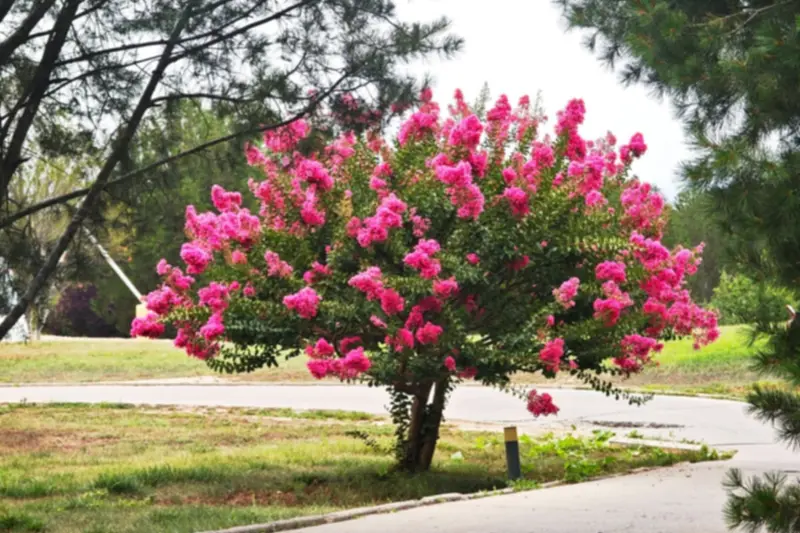
Get an estimate for crape myrtle pruning
Pruned to standard
Cuts made outside the branch collar, no topping and no more removed than the tree can spare, following ANSI A300 pruning standards.
Insured crews, safe rigging
Liability and workers compensation coverage, and limbs lowered on ropes rather than dropped when a roof, fence or garden is below.
A written, itemized price
Removal, stump grinding and cleanup priced separately in writing, so you know exactly what is included before work starts.
Why choose us
Trees handled safely, yards left clean
Most tree jobs here happen over a roof, a fence or a neighbor's yard. Careful rigging, proper pruning cuts and a thorough cleanup are what separate good tree work from a costly mess.
- Insured for tree work
- Limbs lowered, not dropped
- Pruning to ANSI A300
- Stump grinding available
- Written, itemized estimates
- Local to Cary
Why crape myrtles get topped, and why it is a mistake
Crape murder, cutting every trunk back to the same height each winter, is so common in the South that many people think it is required. It is not. NC State Extension advises against it, and the results show why: the cuts leave swollen knuckles that never heal into a smooth trunk, the tree pushes out a mass of thin whip sprouts from each knuckle, and those sprouts carry flower clusters so heavy that they bend and droop. Blooming is often delayed, the weak sprouts are prone to breaking, and the tree has to be cut again the next year to look the same.
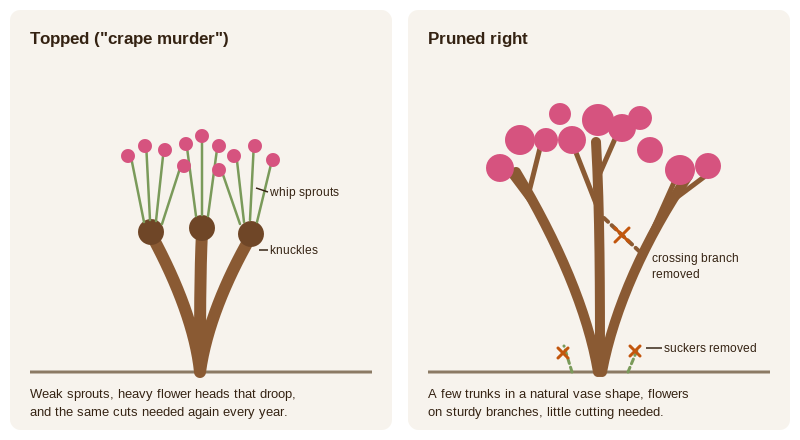
How a crape myrtle should be pruned
Proper crape myrtle pruning is light and selective:
- Remove suckers sprouting from the base and roots, and water sprouts on the trunks.
- Take out dead, broken and diseased wood.
- Remove crossing and rubbing branches, and those growing inward toward the center.
- Thin crowded trunks on multi-stem trees, usually to three to five well-spaced trunks.
- Raise the canopy by removing lower side branches if you want to show off the bark.
- Cut back to a junction or the trunk, never to a stub in the middle of a branch.
Removing spent seed heads from small trees within reach is optional and mostly cosmetic.
When to prune
Late winter is the time, roughly January to early March in the Triangle, before the buds break. Crape myrtles flower on the current season’s growth, so pruning while dormant costs no blooms, and the branch structure is easy to see without leaves. Avoid heavy pruning in late summer and fall, which can push tender growth that frost damages.
Too big for its spot? Choose the right variety
Most topping happens because a crape myrtle has outgrown its space. Crape myrtles range from dwarf varieties of a few feet to tree forms over 25 feet tall, and no amount of pruning turns a large variety into a small one for long. Extension offices recommend choosing a cultivar whose mature size fits the space. If a large variety is crowding a window or a walkway, it may be better to move it or replace it with a smaller one; tree planting can help with the swap.
Restoring a topped crape myrtle
A tree that has been topped for years can usually be rehabilitated. In the first winter, choose two or three strong, well-placed sprouts on each knuckle and remove the rest. Over the next one or two seasons, thin those to the best one per knuckle and let it grow into a branch. The knuckles remain, but the tree regains a natural shape and stronger branches, and it stops needing to be cut back every year.
Crape myrtle bark scale
Crape myrtle bark scale, an invasive insect first found in North Carolina in 2016, is now common in parts of Wake County. Signs include white, felt-like scale insects in bark crevices and branch crotches, sticky honeydew, and black sooty mold coating the trunks. Extension guidance favors a systemic insecticide applied as a soil drench in spring, which must be done by a licensed applicator when it is a paid service. Washing the trunks with a soft brush and mild soap removes some scale and sooty mold. See tree disease and pest treatment for how treatment works.
Crape myrtle pruning — common questions
When should crape myrtles be pruned in North Carolina?
In late winter, roughly January to early March, before new growth starts. Crape myrtles bloom on new wood, so pruning then does not cost you flowers. Dead or broken branches can be removed at any time.
What is crape murder?
The common practice of cutting crape myrtle trunks back to the same height every year. It leaves knobby knuckles and produces thin sprouts whose heavy flower clusters droop, and NC State Extension advises against it.
Can a topped crape myrtle be fixed?
Usually, over two or three seasons. The best sprouts on each knuckle are kept to become new branches and the rest are removed, so the tree gradually regains a natural shape.
What is the black coating on my crape myrtle's bark?
Often sooty mold growing on the honeydew from crape myrtle bark scale, an invasive insect found in North Carolina since 2016 and now common in parts of Wake County. Look for white, felt-like scale insects in the bark crevices.
Often booked with this