Leaning tree: when it is dangerous and what to do
Plenty of trees lean and stand for decades. The ones to worry about are leans that are new or getting worse, especially with the soil cracking or lifting on the far side.
What you may notice
- A tree that has started leaning, or leans more than it used to
- Cracked, mounded or lifted soil on the side away from the lean
- Roots exposed, snapped or pulling out of the ground
- A lean that appeared after a storm or heavy rain
- The house, a driveway or a play area within the tree's height
Tell us about the tree
Pruned to standard
Cuts made outside the branch collar, no topping and no more removed than the tree can spare, following ANSI A300 pruning standards.
Insured crews, safe rigging
Liability and workers compensation coverage, and limbs lowered on ropes rather than dropped when a roof, fence or garden is below.
A written, itemized price
Removal, stump grinding and cleanup priced separately in writing, so you know exactly what is included before work starts.
Natural lean or a warning sign?
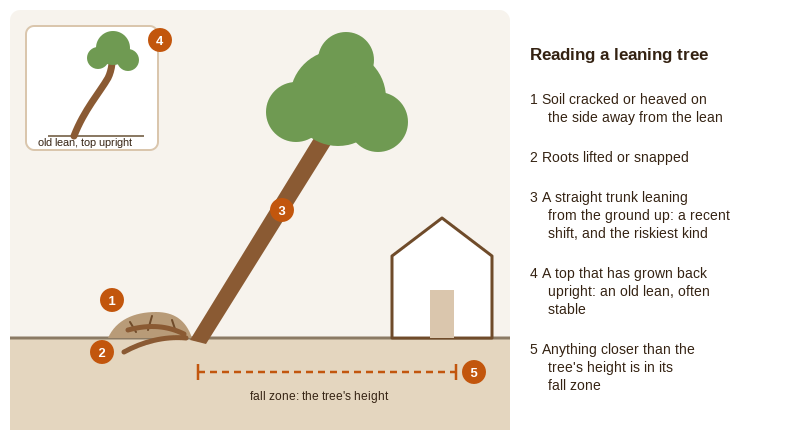
Trees lean for ordinary reasons: they grow toward light at the edge of a woodland or away from a taller neighbor, or they were bent when young and grew that way. A tree that has leaned the same way for many years has built extra wood on the side that bears the load, and often its top has curved back toward vertical. That kind of lean, called a corrected lean, is usually stable.
A lean that is new, or one that is increasing, is different. It means the roots or the soil have given way, and the tree is now relying on less anchorage to hold more weight.
Warning signs at the roots
The most important evidence is on the ground on the side opposite the lean, where the roots are under tension:
- Cracked or heaved soil, a raised mound or a crescent of cracks around the base.
- Exposed or lifted roots, sometimes with fresh tears or snapped ends.
- A gap between the trunk and the soil on the side facing the lean.
- Soggy, saturated soil, which lets roots slip, especially after days of rain.
Any of these with a lean that has appeared or grown recently is a reason to keep people out of the area the tree could reach and get it looked at quickly.
Other things that raise the risk
- The trunk is straight from the ground up, with no curve back toward vertical, which suggests a recent shift.
- Roots were cut or buried by a driveway, a trench, a patio or new fill.
- Decay at the base, such as mushrooms, a cavity or soft wood.
- Heavy weight on the leaning side, with more of the crown hanging over the lean.
- The tree is exposed after nearby trees were removed, leaving it to face the wind alone.
How far can it reach?
A tree’s fall zone is roughly its height from the base, in the direction it leans, and a little more if it could tip the root plate up. If the house, a garage, a driveway, a play set or a neighbor’s property is inside that distance, a leaning tree deserves more attention than one leaning toward an empty woodland. An arborist tree assessment weighs both how likely the tree is to fail and what it would hit.
What can be done
The options depend on what is causing the lean:
- Monitor: a long-standing, corrected lean with sound roots may need nothing more than a periodic look. Marking the trunk and a stake can show whether the lean is changing.
- Reduce the weight: pruning to lighten the crown on the leaning side lowers the strain on the roots.
- Support: on some multi-stem trees, cabling and bracing can help, though cables cannot hold up a tree whose roots are failing.
- Remove: a recent lean with root plate movement, decay or a valuable target in the fall zone usually means tree removal, and soon.
Leaning trees in Triangle soils
Clay soils across the Triangle hold water after long rains, and saturated clay loses strength. That is why so many trees here tip over during hurricanes and tropical storms that dump inches of rain before the wind arrives. Pines on lots where roots were damaged during construction are especially prone. If a tree near your house has started to lean, do not wait for the next storm to find out how well it is anchored; the guide to preparing trees for hurricane season explains what else to check.
Leaning tree — common questions
Can a leaning tree be straightened?
Young trees with small root systems can sometimes be staked upright. Mature trees cannot: pulling them straight tears the roots that are holding them up. A leaning mature tree is either stable as it is, supported, or removed.
How much lean is too much?
There is no fixed angle. A tree that has leaned the same way for decades and grown its top back upright can be stable at a steep angle. A tree that moved recently can be dangerous at a slight one.
My tree started leaning after heavy rain. Is it an emergency?
Treat it as one if the soil is cracked or lifting on the far side, or the tree could hit a house, car or people. Keep everyone out of the area where it would fall and call for an assessment.
Does insurance cover removing a leaning tree?
Usually not before it falls. Insurers treat removing a standing tree as maintenance. If a tree you knew was dangerous then falls on a neighbor's property, ignoring it can make you responsible.
Other tree problems
Not sure whether the tree is safe?
Call and describe the tree and what is near it, or send a few details and we will get back to you.