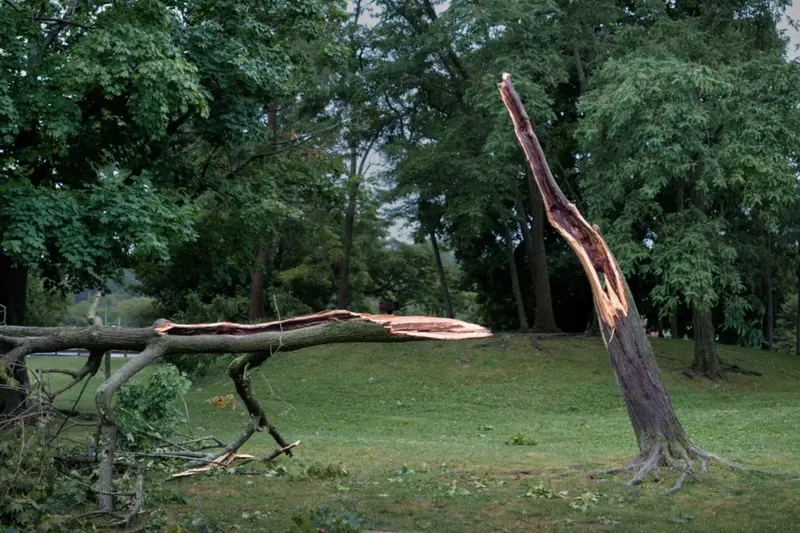
Storm-damaged tree: split trunks and hanging limbs
After a storm, some damaged trees just need cleanup pruning, and some are a hazard waiting for the next gust. Knowing the difference starts with what broke, and where.
What you may notice
- A trunk or fork split open, with fresh wood showing
- A broken top or limb hung up in the crown
- Branches torn off, leaving ragged stubs
- The tree tilted, with soil lifted at the base
- Limbs resting on the roof, a fence or wires
Tell us about the tree
Pruned to standard
Cuts made outside the branch collar, no topping and no more removed than the tree can spare, following ANSI A300 pruning standards.
Insured crews, safe rigging
Liability and workers compensation coverage, and limbs lowered on ropes rather than dropped when a roof, fence or garden is below.
A written, itemized price
Removal, stump grinding and cleanup priced separately in writing, so you know exactly what is included before work starts.
Stay safe first
Storm-damaged trees hide dangers that are easy to miss:
- Wires: limbs can be resting on power, cable or phone lines, which may be energized. Stay away and call the utility.
- Hangers: broken limbs caught in the crown can fall without warning. Do not stand or park under them.
- Tension: bent limbs and trunks pinned under other wood are loaded like springs and can whip when cut.
- Root plates: a partly uprooted tree can settle or tip further, especially in wet soil.
Photograph the damage before anything is moved, both for your records and for any insurance claim.
Types of storm damage
- Broken branches: limbs snapped off, leaving ragged stubs. The most common and most fixable damage.
- Hangers: broken limbs or tops caught in the canopy.
- Split forks: two stems of a V-shaped fork pulled apart, often where bark was trapped between them.
- Broken tops: the leader snapped off, common in pines in ice and wind.
- Uprooting: the root plate lifted partly or fully out of saturated soil.
- Lightning damage: a strip of bark blown off down the trunk, sometimes with a split.
Which trees can be saved?
Arborists often weigh three questions after a storm. Is the tree basically healthy and sound apart from the new damage? Does it still have at least about half of its crown, including its main leader or most of its major limbs? And are the trunk and roots intact? A tree that passes all three can often be restored with proper pruning. A tree that fails any of them, especially with a split trunk, a lifted root plate or a lost leader on a tall tree, is usually a removal. An arborist tree assessment settles the borderline cases.
Repairing a damaged tree
Restoration pruning cleans up the damage so the tree can recover:
- Ragged stubs are cut back to the branch collar or to a healthy side branch, so the wounds can close.
- Hangers and loose limbs are removed.
- Torn bark is trimmed back to solid edges.
- Crowns that lost limbs on one side may be lightly balanced over a few years rather than all at once.
- A small split at a fork may be held together with cabling and bracing.
Avoid topping a storm-damaged tree to make it shorter; the regrowth is weaker than what broke. Tree trimming covers how cuts are made.
Why Triangle storms bring trees down
The Triangle sees three kinds of tree-damaging weather, and each breaks trees differently. Tropical systems moving inland soak the clay before the strongest gusts arrive, so whole trees tip over, roots and all. Summer thunderstorms bring short, violent downbursts that snap tops and tear limbs out of otherwise healthy crowns. Ice storms load every twig until branches, and sometimes whole pines, bend and break under the weight. Weak-wooded species such as Bradford pears and water oaks tend to fail first in all three.
Check the trees that look fine
A storm can loosen roots or crack a fork without leaving obvious damage. In the days afterward, walk the yard and look for new leans, cracked soil around the base of trees, fresh splits at forks, and clusters of dead leaves hanging in a green crown, a sign that a broken limb is still caught up there.
After the storm
When trees are on the house, cars or driveway, or hung up over anywhere people go, emergency tree removal is the next call. For everything else, wait for a calm day and get the damage assessed before cutting. If insurance is involved, the guide to fallen trees and insurance explains what policies usually pay for.
Storm-damaged tree — common questions
Can a split tree be saved?
A small crack in an otherwise healthy tree can sometimes be braced and cabled. A trunk split down the middle, a fork torn wide open or a split with decay inside usually cannot, and the tree should come down.
What is a widowmaker?
A broken limb or top that is hung up in the crown, held only by other branches. It can fall at any time, so keep people out from underneath until a climber or bucket crew brings it down.
Should I prune storm damage myself?
Small broken twigs within reach from the ground are fine to clean up. Anything that requires a ladder, a chainsaw overhead or work near wires is dangerous after a storm and is best left to a crew.
Will a tree recover after losing branches in a storm?
Healthy trees often do, if the broken branches are cut back properly and the tree kept most of its crown. A tree that lost more than half of its crown, or its main leader, often does not.
Other tree problems
Did the limb take out a fence panel or deck railing? Apex Handyman fence and deck repair
Not sure whether the tree is safe?
Call and describe the tree and what is near it, or send a few details and we will get back to you.