Tree cabling and bracing in Cary, NC
A big tree with a weak fork or a small split does not always have to come down. Cables and brace rods share the load between stems, adding years of safe life to a tree worth keeping.
- Weak V-shaped forks and codominant stems supported
- Static steel or dynamic synthetic cable systems
- Brace rods through split or cracked unions
- Installed to the ANSI A300 support standard
- Annual inspection of installed hardware
Covering Cary · Apex · Holly Springs · Morrisville · Raleigh
Get an estimate for tree cabling and bracing
Pruned to standard
Cuts made outside the branch collar, no topping and no more removed than the tree can spare, following ANSI A300 pruning standards.
Insured crews, safe rigging
Liability and workers compensation coverage, and limbs lowered on ropes rather than dropped when a roof, fence or garden is below.
A written, itemized price
Removal, stump grinding and cleanup priced separately in writing, so you know exactly what is included before work starts.
Why choose us
Trees handled safely, yards left clean
Most tree jobs here happen over a roof, a fence or a neighbor's yard. Careful rigging, proper pruning cuts and a thorough cleanup are what separate good tree work from a costly mess.
- Insured for tree work
- Limbs lowered, not dropped
- Pruning to ANSI A300
- Stump grinding available
- Written, itemized estimates
- Local to Cary
Which trees benefit from support
Cabling and bracing are for trees that are worth keeping but have a structural weakness:
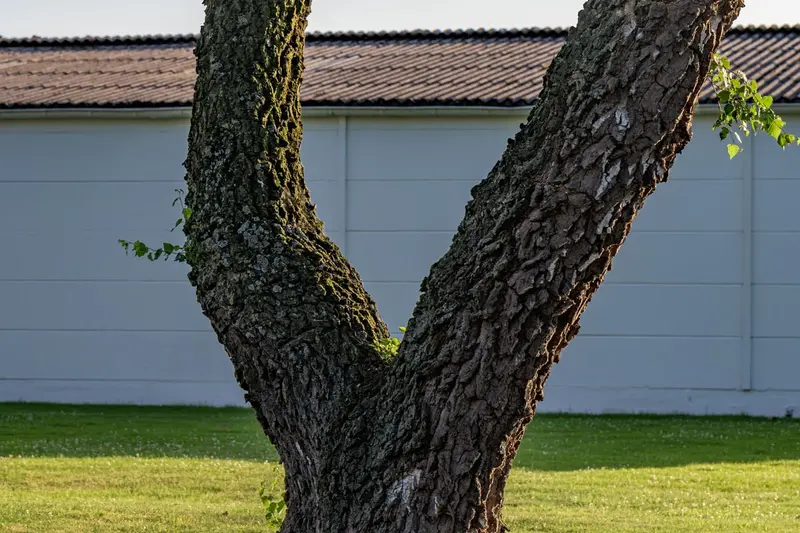
- Codominant stems: two trunks of similar size growing from a single V-shaped fork, often with bark trapped between them, called included bark, which makes the union weak.
- A small crack or split at a fork, especially after a storm.
- Long, heavy limbs extending over a house or driveway.
- Multi-stemmed trees whose stems lean away from each other.
- Valuable or historic trees where removal is a last resort.
Cabling is not appropriate for a tree with extensive decay in the union or the trunk, one that is dead or dying, or one that has already failed beyond repair.
How cabling works
A cable connects two stems high in the crown, typically about two-thirds of the way from the fork to the tips, so that when wind pushes one stem, the other shares the load instead of the fork taking all the strain. Anchors are installed through or into the wood, never by wrapping cable around a limb, which would strangle it as it grew. Cables are installed with a little slack so the stems can still move and build strength, and they act as a safety net in high winds.
- Static systems use galvanized steel cable with eye bolts or lag hooks. They are strong and long-lasting.
- Dynamic systems use synthetic rope with shock-absorbing properties, installed without drilling through the stems in many cases. They allow more natural movement and suit some situations well.
How bracing works
Bracing places threaded steel rods through a split or weak union, usually below the fork, to hold the two sides together and keep the crack from opening or twisting. Rods are often combined with a cable above, because the rod handles the twisting at the union while the cable limits how far the stems spread. Bracing is also used to reattach a limb that has partly torn but is still sound, when the tree is otherwise healthy.
The standard behind the work
Supplemental support systems are covered by part of the ANSI A300 standard, which sets out where hardware goes, what kind, and how it is sized for the tree. Following it matters: an undersized cable, a misplaced anchor or a cable installed too low can fail in exactly the storm it was meant for. Ask the arborist which system they recommend and why, and for the details of the hardware in writing.
Inspection and maintenance
A support system is not a one-time fix. Trees grow, hardware can loosen or wear, and wood around anchors can decay. Plan on an inspection about once a year, and after major storms, to check the cable tension, the hardware and the condition of the union. Steel cables are often replaced or adjusted after a decade or more; synthetic systems follow the manufacturer’s service life.
Trees worth cabling, and trees that are not
Support makes the most sense on long-lived, sound species where the tree adds real value: a big willow oak, white oak or red maple shading the house, or a mature specimen in the front yard. It rarely makes sense on short-lived, weak-wooded trees. Bradford pears, for example, tend to split at their tight forks no matter what is installed, so the money is usually better spent on removal and a replacement.
Cabling, pruning or removal?
Support systems work best alongside tree trimming that reduces the weight on the stems being supported. The decision between cabling a tree and removing it depends on how sound the wood is, what the tree would hit, and how much the tree is worth to you; an arborist tree assessment answers those questions. If a storm has already split the tree badly, emergency tree removal may be the safer path.
Tree cabling and bracing — common questions
How long does tree cabling last?
Steel cable systems commonly last ten years or more, and synthetic systems have a shorter service life set by the manufacturer. Every system needs inspecting about once a year, and more often after storms, because trees grow and hardware wears.
Will cabling save a tree that has already split?
Sometimes. A small crack at a fork can often be braced and cabled. A large split, a fork that has opened widely or a tree with significant decay usually cannot be made safe and is better removed.
Does cabling hurt the tree?
Installing the anchors creates small wounds, which healthy trees seal over. Properly installed hardware does not girdle the branches, which is why wrapping cables around limbs, the old method, is no longer used.
Is cabling a substitute for pruning?
No. It works with pruning. Reducing the weight on the stems being supported lowers the load on the cable and the fork, and an arborist usually recommends both.
Problems this fixes
Often booked with this